Bullet Train Vs Vande Bharat Express: Full Comparison
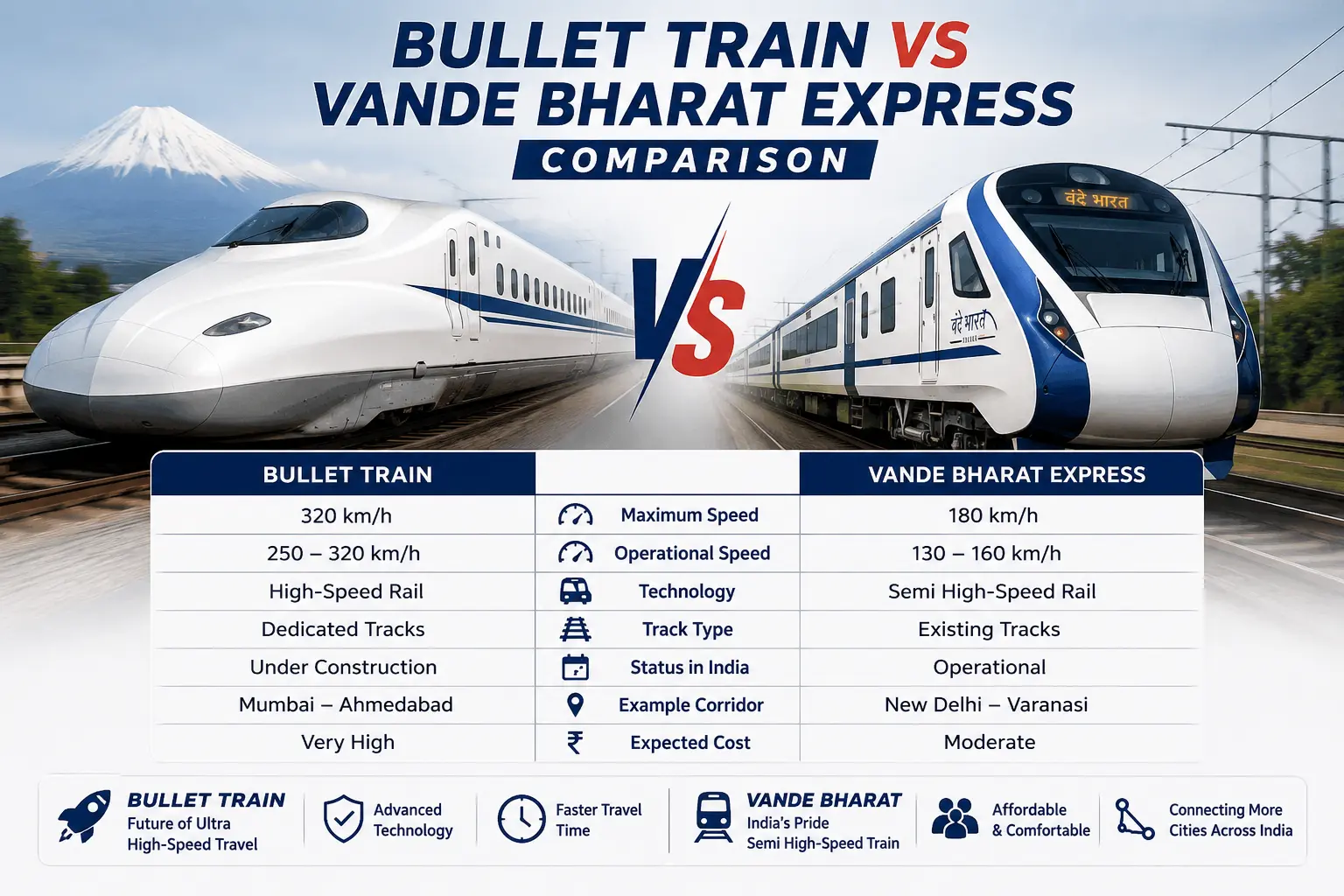
In the realm of high-speed rail travel in India, two names stand out prominently: the Bullet Train and the Vande Bharat Express. Both trains have revolutionized the way Indians travel, offering unprecedented speed, comfort, and efficiency. However, they cater to different needs and preferences. In this article, we will compare the Bullet Train and Vande Bharat Express across various parameters to help you understand their differences and choose the right one for your next journey.
What is a Bullet Train?
A Bullet Train is a high-speed train designed to travel at very high speeds on specially built railway tracks. The upcoming Mumbai–Ahmedabad Bullet Train project in India is based on Japan's famous Shinkansen technology. These trains can reach speeds of up to 320 km/h, making them one of the fastest modes of land transportation. Bullet trains use dedicated tracks, advanced safety systems, and modern engineering to provide quick and comfortable travel between cities.
What is Vande Bharat?
Vande Bharat Express is India's modern semi-high-speed train developed under the Make in India initiative. Unlike Bullet Trains, Vande Bharat operates on the existing Indian railway network. The train offers modern features such as comfortable seating, automatic doors, improved safety systems, onboard Wi-Fi in selected routes, and faster acceleration compared to traditional trains. Although its maximum design speed is 180 km/h, it generally operates at speeds between 130 and 160 km/h depending on the route.
Differences
The biggest difference between Bullet Trains and Vande Bharat trains is speed and infrastructure. Bullet Trains require completely separate high-speed railway corridors, while Vande Bharat trains run on the existing railway tracks. Bullet Trains are designed for ultra-fast travel between major cities and can reach speeds of up to 320 km/h. In contrast, Vande Bharat focuses on improving travel experience and reducing journey times within the current railway network.
Another important difference is cost. Building a Bullet Train network requires significant investment in tracks, stations, signaling systems, and safety infrastructure. Vande Bharat trains are comparatively more affordable because they utilize existing railway infrastructure. This allows Indian Railways to introduce them on many routes across the country more quickly.
| Feature | Bullet Train | Vande Bharat |
|---|---|---|
| Maximum Speed | 320 km/h | 180 km/h |
| Operating Speed | 250–320 km/h | 130–160 km/h |
| Track Requirement | Dedicated High-Speed Tracks | Existing Railway Tracks |
| Technology | High-Speed Rail | Semi High-Speed Rail |
| Status in India | Under Development | Operational |
Similarities
Despite their differences, both trains represent India's push toward faster, safer, and more comfortable railway travel. Both use modern technology, advanced safety systems, improved passenger amenities, and energy-efficient designs. Their main goal is to reduce travel time while providing a better travel experience than conventional trains.
Both trains are expected to play an important role in improving connectivity between cities, supporting economic growth, and encouraging more people to choose rail transport over road or air travel for certain routes.
Which Train Is Better for India?
The answer depends on the context. For long-distance travel between major cities, Bullet Trains will offer unmatched speed and convenience. However, they require significant investment and time to build the necessary infrastructure. Vande Bharat trains are a more practical solution for improving travel times on existing routes in the short to medium term. They can be deployed quickly and cost-effectively across many routes, benefiting a larger number of passengers sooner. In the long run, both trains will complement each other, with Bullet Trains serving high-demand corridors and Vande Bharat trains enhancing connectivity on secondary routes.
Conclusion
Bullet Trains and Vande Bharat trains are designed for different purposes. Bullet Trains focus on ultra-high-speed travel using dedicated infrastructure, while Vande Bharat aims to modernize India's existing railway network at a lower cost. While the Bullet Train represents the future of high-speed rail in India, Vande Bharat is already transforming railway travel today. Together, they showcase India's commitment to building a faster, safer, and more modern transportation system.